|
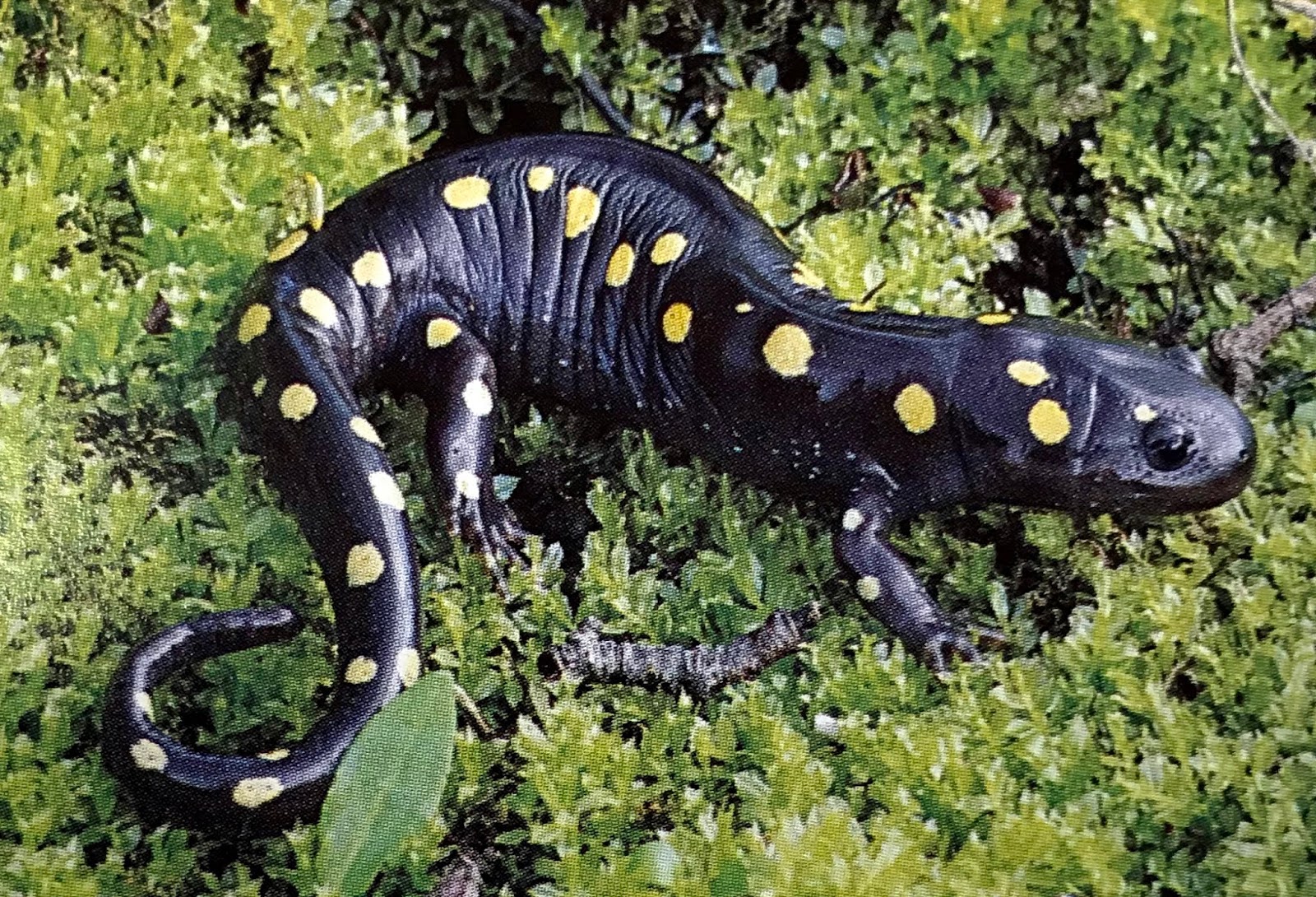
| Adult Yellow Spotted Salamander |
Despite the fact that our
Ted (Watt) Talk on spotted salamanders was cancelled does not mean
that the spotted salamanders have cancelled their yearly migration to the vernal pools and
ponds of Heath.
The yellow spotted salamander is one of the more elusive inhabitants of Heath. For most of the
year it lives underground and only emerges in the spring time to breed and lay eggs in wetlands
and vernal pools. When on the move the breeding is most successful in vernal pools because
these are areas that dry up in the summer time and that means their predators, fish and newts
don’t live there.
When the conditions are just right, most of the salamanders will head for the pools on one
night. In Amherst, they call it Big Night and it is very exciting to see. Folks come out to watch
but to also keep the critters safe from cars since salamanders don’t know about roads. We
encourage you to do this in Heath as well.
And please keep track of what you see. Print and use
this form (Google Drive PDF.) Take a photo of your completed form and email it to us (
heath.library@gmail.com) at the library. We will post the results on the library website.
Big Night occurs each spring when spotted salamanders and wood frogs migrate from their
winter woodland habitats to nearby wetlands to breed. During the first warm spring rains,
usually in April, after dark and with a stable temperature of 40 degrees or above amphibians
are likely to be moving. The ice has to be melted off the water as well. We recommend that
you find a road that is less traveled by and look for the salamanders there. If you go into the
woods when they are migrating you may hurt or kill them by accidentally stepping on them. In
the past they have been sighted on Swamp road, down Hosmer Rd on the Fairground end, Long
Hill Rd. and Stone Hill Rd.
Below are the guidelines that the Hitchcock Center in Amherst suggests.
- If you have reflective clothing, please wear it for safety.
- Please do not touch the animals unless they are in danger while on the road. If
you do have to help one, please do not carry them in your hands, use a wet leaf.
The very best thing to do is find the volunteers whose job will be to have buckets
ready for collecting critters on the road.
- Please make sure your flashlights are covered in red cellophane because regular
light can impact the migrating creatures.
- Be very careful if you have to cross the road as the vehicles can have difficulty
seeing you. DO NOT TAKE ANY CHANCES, CARS WILL NOT BE ASKED TO SLOW
DOWN.
- Please be aware of where your children are at all times and make sure they and
you know the rules to correctly enjoy the salamander and frog migration. For
young children, please accompany them at all times for everyone's safety.
More information can be found in this
Highlights Magazine article or google
animalfactsguide.com and wildlifelandtrust.org .
If you miss the Big Night, don’t forget that the ponds and vernal pools in the spring are teaming
with new life. They are a great place to study life cycles and critters. Even when you are social
distancing you can enjoy the company of our natural world.
Two more good sources of information on the spotted salamanders suggested by our good friend Ted Watt:
https://www.gazettenet.com/Earth-Matters-24295214
An article Ted wrote for the Gazette about the Henry Street tunnels. But has some good natural history, too.
https://harriscenter.org/programs-and-education/citizen-science/salamander-crossing-brigades/faq#what-is-big-night
The Harris center in southern New Hampshire is another of the regional leaders in salamander natural history and monitoring. Their site has everything anyone could want to know.